
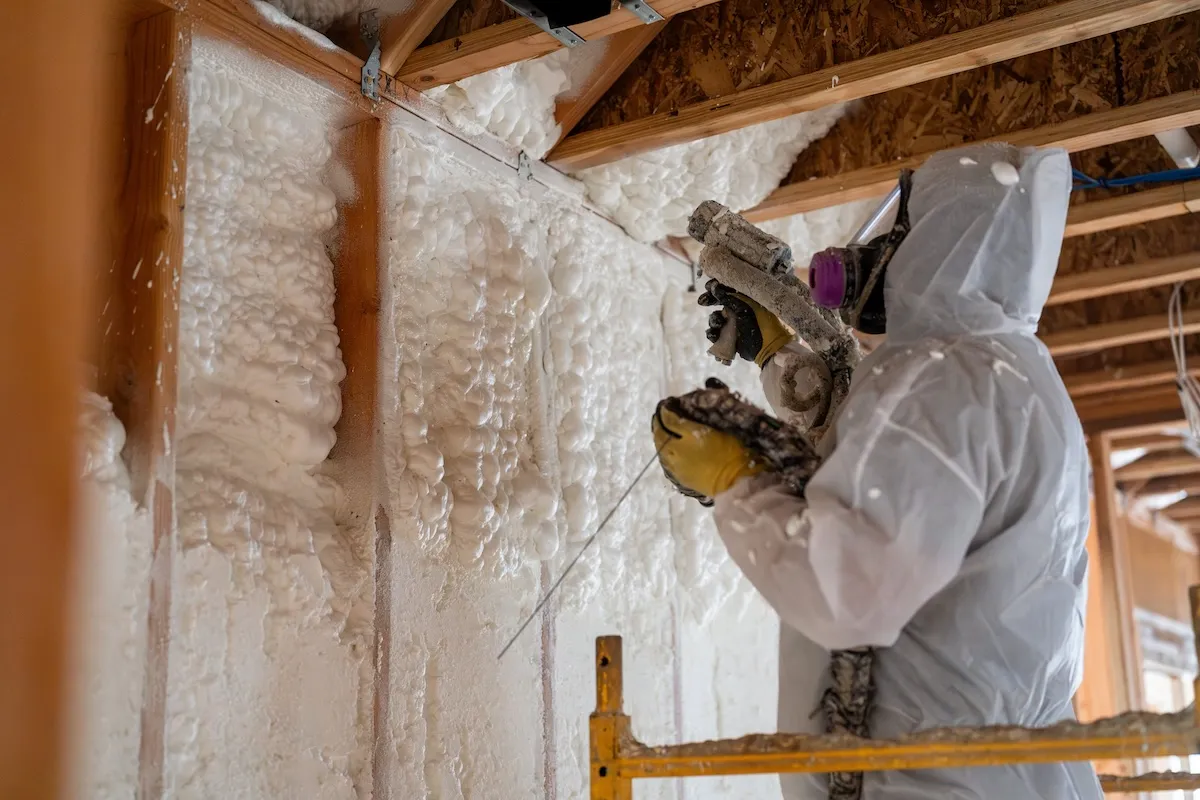
Spray foam expands to fill every gap, sealing air leaks while delivering one of the highest R-values per inch available. Ideal for attics, walls, and crawlspaces where performance matters.
What you get
Highest R-value per inch of any common insulation
Closed-cell foam delivers roughly R-6.5 per inch — nearly double traditional batts. That lets you hit code R-values in tight assemblies where batts physically won't fit, like cathedral ceilings and 2x4 exterior walls.
Air-seals as it insulates
Most heat loss in a typical home is air leakage, not conduction. Foam expands into every crack and penetration as it cures, doing the work of insulation and an air barrier in a single pass — something batts and blown-in can't match.
Resists moisture, mold, and pests
Closed-cell foam doesn't absorb water and doesn't give rodents or insects anything to nest in. It's the right choice for crawlspaces, rim joists, and anywhere moisture has been a recurring problem.
Adds structural rigidity to walls
Closed-cell foam bonds to studs and sheathing as it cures, measurably stiffening the wall assembly. It's a real structural bonus on retrofits where you're already opening up walls.
How it works
- 1
Site prep
We mask and protect surfaces around the work area.
- 2
Application
Closed- or open-cell foam sprayed to specified thickness.
- 3
Trim
Excess foam trimmed for a clean finish.
- 4
Cleanup
Work area cleaned and walked through with the homeowner.
Frequently asked
Open-cell or closed-cell?
We help you choose based on the assembly. Closed-cell for moisture resistance and structural value; open-cell for budget-friendly interior applications.